How anyone with a grudge can weaponize a Nevada County department against your home, and make you pay for the bullets.
By 530 UTOPIAN ·
Property
One
Complaints
Three
Sworn statements
Zero
Where they stand
Closed, unfoundedCitedOpen
You can order a hit on anyone from your couch. Sign the County’s online complaint form, no oath required, and an inspector shows up at their property. Cheaper than buying a Saturday night special at a gun show, just as damaging and perfectly legal. Welcome to Nevada County.
Cold open
A Saturday afternoon. A refund, refused.
2:13 p.m.
Three minutes after the first threat, the renter named the price.
The renterThat’s fine, don’t give me the rent back but all the authorities will be informed
The ownerYou do recognize blackmail, right?
The renterTenants rights
The renter, same minuteIf you did nothing wrong you won’t get in trouble.
It was a Saturday afternoon. By Monday there would be a complaint.
01The first time
A renter, eleven days in. A refund.
The couch
Mold was one of the renter’s first questions. The owner told them about the one spot he knew of, under the kitchen sink. They came for a trial week and left “very positive about everything.”
Eleven days into the real stay they left on a trip and wrote back that they felt better every time they slept somewhere else. That evening someone turned over the couch they’d been sleeping on. The underside of one cushion was moldy. By the next afternoon the building had been cleaned.
That morning the renter asked for their rent back. A housemate answered, with a photo of the cushion, that no refund was justified.
I will contact the county and let them know my situation and the living space offered which is definitely an illegal rental.
2:13–2:14
Then the price, and the theory.
Next two hours
A lawsuit (“I’d guess that’s $5-10k”), then the police.
Good luck in court.
A complaint form reached Nevada County Code Compliance dated that Monday. Its boxes are checked for an unpermitted building, a home business and an unsafe dwelling. None of them says refund. The form has no box for one.
A week later an officer drove onto the property, found the building in use for storage, and closed the case as unfounded.
Two and a half weeks after the case closed, the household paid the renter $400. That isn’t in the County’s file.
[OBSERVED] Written messages held by the owner, quoted as sent and not published. The County’s case file for the property. The County redacted the name of the person who filed; the link to the renter rests on the timing and the written threats.
Between the first and the second
The price list
To file
A signature
Filing costs you almost nothing. You put your name on the County’s form and sign it. Nobody asks you to swear it’s true. Nobody asks whether you’re in a fight with the person you’re reporting. The County won’t tell them it was you. Then the form asks you to be patient for four to six weeks.
To be named
A case
Being on the other end costs a lot more. An inspector can be at your property within ten days. If they find a problem, you get a warning letter, and you have five days to appeal it. Then come the fines. These are the ceilings. Nobody will tell you the price.
$130First
→
$700Again, within a year
→
$1,300Every one after that
The County’s code sets no amount for a citation — only that it cannot go above those. So no one can tell you in advance what a violation will cost. The bill can also include the hours its staff spent on your case.
Knowingly filing a false complaint is a crime under the County’s own rules. The form doesn’t tell you that.
This tenant had lived on the property about a year, and for most of it they were friends. Shared dinners. Rides. One month they paid rent early, “as a courtesy because it sounded like you were really hurting.”
In the summer the water failed, and the tenant threatened to report it: “I have the number of the city rental board on autodial.” That was a fair threat, the kind of report the law protects. Four days later the owner found the cause and the water came back. No complaint followed.
In the fall the tenant moved out. They skipped the walk-through they’d scheduled and left the cottage unlocked. By the time the owner got in, things were missing. The tenant still wanted the deposit back. For a couple of weeks they were easy about it. Then they weren’t.
Mon 9:21 p.m.
Start making payments tomorrow. You can do $100 a week. Then: You have a week.The owner wrote back that the deposit was gone. He had spent it covering rent other people hadn’t paid.
Tue 11:00 a.m.
I fear you will not give it to me unless I harass you and threaten you.
Sun 9:27 p.m.
By now he had paid $300If we cannot reach a resolution by Friday for a payment plan I will be taking you to court and calling code enforcement.
9:48 p.m.
The owneryou calling code enforcement will literally just result in making me homeless.
9:49 p.m.
And you are about to be more fucked. Get me my money from your mom or uncle. I don’t care. I am done with you. You have until 4pm and then I will be calling code enforcement.
Tue night
The tenant said they had “warned everyone on your property”: “don’t bother paying last months rent.” Then a list of everything wrong with the place.
Then
I will figuratively burn you to the ground for not paying me back.
A week later
A complaint was dated. Its list of problems closely tracks the one the tenant had texted the owner.
Five nights later, 11:42 p.m.
That day the County had dated a warning letter to the ownerHave you met Dave yet? He is the code compliance officer addressed to your case.
11:49 p.m.
you dragged it out and made me come after you.
That case went to a citation hearing.
[OBSERVED] Written messages held by the owner, quoted as sent and not published. The condition of the cottage at move-out is the owner’s account; the scheduled walk-through is in the messages. The County’s case file for the property. The filing date in the County’s file and the date in the owner’s notes differ by about a week; the sequence above holds on either.
03The third time
A guest who stayed on. A move-out date.
The van
They arrived in the spring with a van and stayed on, helping out the way a long-term guest does. Early in the summer they wrote that they’d be leaving in two weeks and signed off “YOU’RE THE BESTEST.” They didn’t leave.
A week before it all broke, they told the owner:
“I have dealt with both building and code enforcement for nearly a decade up here.”
Then the owner tried to put the help into a written work-trade agreement. It went bad fast, and no agreement was ever made. The owner put a move-out date in writing.
If you wanna be a dick... I can play. You won’t like it tho.
there are a few reports I need to file with some organizations.
Every authority they named, in order
The day beforeAdult protective services
7:05 p.m.“Some organizations”
Within ten daysThe district attorney
Within ten daysThe sheriffCalling sheriff to file another report now.
Then a truce, then more fights.
Seven weeks after the move-out dateCode ComplianceA written complaint
The complaint · from the County record · quoted as written
“Hello David.”
“Not sure if you remember me but we met a few years ago”
at another property, where the guest says they had been evicted.
“Not sure how I manage, but again find myself on a property under your management.”
Where they were living:
“in my van and then in a storage shed, yes Im aware, not code compliant.”
On the owner, to the officer:
“I understand your frustration with [the owner] because he truly is a complete jerk that believes he is the smartest human on Earth.”
On what else they had:
“I as well as a previous tenant … have a very long list of code violations that are not on your report.”
And the invitation:
“to come onto the property as my guest in your official capacity.”
That case is open.
[OBSERVED] Written messages held by the owner, quoted as sent and not published. The complaint’s text, from the County record, quoted as written.
The pattern
Side by side.
One tactic, three times
01The couch
02Friday
03The van
What set it off
A refund, refused
A deposit, paid in pieces
A move-out date, in writing
The threat, in writing
“I will contact the county…”
“…taking you to court and calling code enforcement.”
“there are a few reports I need to file with some organizations.”
Then the complaint
Dated that Monday
Dated a week later
Seven weeks after the move-out date
What the County did
Closed, unfounded
Warning letter, then a citation hearing
Open
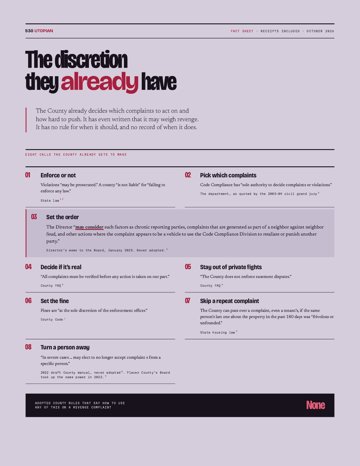
The County had already described this, in writing
Page 3
In January 2025 a division director prepared a twelve-page memo for the Board of Supervisors’ annual workshop. On page 3, under the lower-priority category of cases, is a 53-word sentence:
“When prioritizing cases, the Code & Cannabis Compliance Department Director may consider such factors as chronic reporting parties, complaints that are generated as part of a neighbor against neighbor feud, and other actions where the complaint appears to be a vehicle to use the Code Compliance Division to retaliate or punish another party.”
Board workshop memo, January 23, 2025, page 3
Swap in the details and it reads like a summary of this file. It was written ten months before the second complaint.
The director may consider it, when prioritizing.
In other words, a complaint that looks like revenge can go to the back of the line. It still gets worked. Nothing lets the County stop it, and nothing requires anyone to write down that it looked like revenge.
Asked in writing why a case was opened, the County has answered that it holds no record of that.
The sentence stayed in the packet. The record doesn’t say why.
Where the sentence went
The written memo, in the Board’s packetPage 3
The 18 slides shown to the BoardNot there
The case flowchart shown to the BoardNot there
The official minutesNot there
The County’s websiteNot there
The complaint formNot there
[PUBLISHED]Board workshop memo, January 23, 2025, p. 3 (a division director’s memo for a public workshop; the Board did not adopt it); workshop slides, slides 9–11, 15, 17–18; summary minutes; County FAQ. [OBSERVED] A County public-records response in the campaign’s files, described here by its shape only. [UNVERIFIED] Whether anyone read the sentence aloud at the workshop; only the video would show it.
The owner never sent the itemized list state law requires within 21 days. He says the cottage came back unlocked and short. That fight belonged in small claims court, and he was ready to lose it there.
He wasn’t ready to be cited over buildings he had every reason to believe were legal.
02The finding
Spite doesn’t make a bad roof safe.
The officer also found someone living in a structure that wasn’t approved for it. A complaint filed for the wrong reason can still point at something real.
So the fix never touches a tenant’s complaint about their own home, and never lets danger an officer confirms go unaddressed.
[OBSERVED] The officer’s finding, from the County’s case file. [CODIFIED] Civil Code § 1950.5 (the 21-day itemized statement).
Put a price on it. A sworn statement, and the question the form skips: are you in a fight with this owner?
When there’s a written threat, a complaint filed soon after a refused demand, or a dispute nobody disclosed, the County opens a written review.
Both sides answer.
The County writes down what it finds.
If the threat is proven, the case closes and its fines go.
The person who made the threat is barred from filing about that property and referred to the District Attorney.
A tenant’s complaint about their own home, and any confirmed danger, go forward no matter what.
“If you did nothing wrong you won’t get in trouble,” the renter wrote. Under this rule, that would finally be true. The person making the threat would be the one in trouble.
The division is “complaint driven as directed by the Nevada County Board of Supervisors.” The Board can change that, and staff are rewriting the code compliance manual right now.